八年级下册英语(人教版)全册知识思维导图
中心主题:八年级下册英语 (Grade 8 English, Book 2)
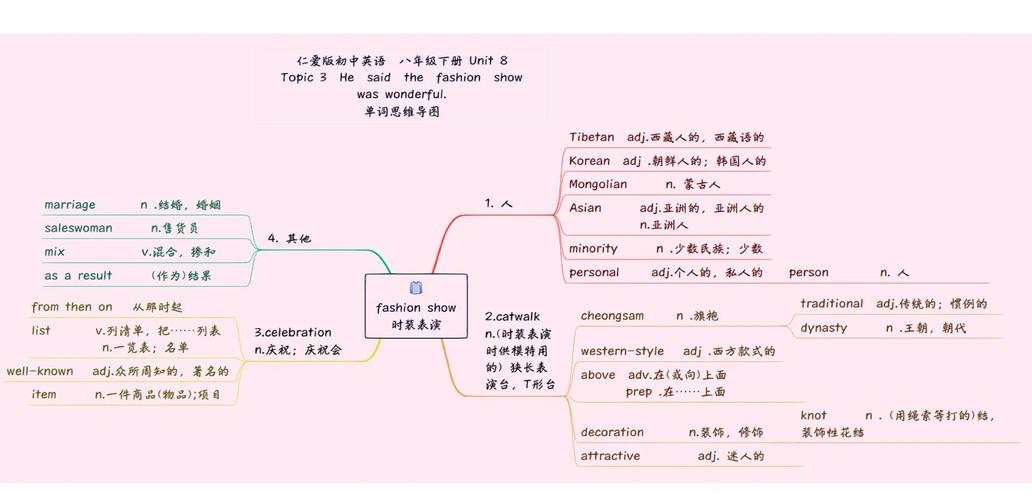
(图片来源网络,侵删)
第一部分:核心语法
分支1:一般将来时 - "will" 和 "be going to"
- 核心概念:表示将来发生的动作或存在的状态。
- 分支1.1: "will" 的用法
- 结构:主语 + will + 动词原形 + ...
- 核心功能:
- 预测/预言:It will be sunny tomorrow. (明天会是晴天。)
- 意愿/承诺:I will help you with your homework. (我会帮你做作业的。)
- 临时决定:The phone is ringing. I'll get it. (电话响了,我去接。)
- 请求/建议:Will you please open the window? (你能打开窗户吗?)
- 分支1.2: "be going to" 的用法
- 结构:主语 + am/is/are + going to + 动词原形 + ...
- 核心功能:
- 计划/打算:I am going to visit my grandparents this weekend. (我打算这个周末去看望我的祖父母。)
- 根据迹象预测:Look at the dark clouds. It's going to rain. (看那些乌云,要下雨了。)
- 分支1.3: "will" vs "be going to" 的区别
- 计划性:
be going to通常指已有的计划;will多指临时决定或预测。 - 预测依据:
be going to有明显迹象;will多为主观看法。
- 计划性:
分支2:情态动词 - "should" 的用法
- 核心概念:表示“应该”,用于提出建议或劝告。
- 结构:主语 + should + 动词原形 + ...
- 核心功能:
- 提出建议:You should drink more water. (你应该多喝水。)
- 表达义务/责任:Students should finish their homework on time. (学生应该按时完成作业。)
- 否定形式:shouldn't (不应该)
- 相关句型:
- Why don't you/ we...? (你/我们为什么不……呢?)
- How about/ What about...? (……怎么样?)
分支3:过去进行时
- 核心概念:表示过去某个时刻正在进行的动作。
- 结构:主语 + was/were + 动词ing + ...
- 核心功能:
- 描述过去特定时间点的动作:I was doing my homework at 8 pm yesterday. (昨晚8点我正在做作业。)
- 描述过去一段时间内持续的动作:They were playing basketball from 4 to 5 pm. (他们下午4点到5点一直在打篮球。)
- 时间标志词:at that time, at 9 o'clock yesterday, this time yesterday, while, when
分支4:现在完成时
(图片来源网络,侵删)
- 核心概念:表示过去发生或已经完成的动作对现在造成的影响或结果,或从过去持续到现在的动作/状态。
- 结构:主语 + have/has + 动词的过去分词 + ...
- 核心功能:
- 表示“已完成”:I have finished my homework. (我已经做完作业了。)
- 表示“未完成”(持续):I have lived here for ten years. (我在这里住了十年了。)
- 表示“经历”:Have you ever been to Beijing? (你去过北京吗?)
- 时间标志词:
- for + 一段时间 (for two hours)
- since + 过去的时间点 (since 2025, since last year)
- already, yet, just, ever, never
分支5:反意疑问句
- 核心概念:在陈述句后加上一个简短的问句,表示疑问或征求对方同意。
- 构成原则:前肯后否,前否后肯。
- 分支5.1: 肯定陈述句 + 否定问句
- You are a student, aren't you?
- He can swim, can't he?
- They will come, won't they?
- 分支5.2: 否定陈述句 + 肯定问句
- You aren't a student, are you?
- He can't swim, can he?
- She doesn't like apples, does she?
- 特殊情况:
- Let's go, shall we?
- Let us go, will you?
- I am right, aren't I?
第二部分:核心词汇
- 分支1: 健康与就医
- 名词:fever (发烧), toothache (牙痛), stomachache (胃痛), sore throat (喉咙痛), cough (咳嗽), headache (头痛), medicine (药), rest (休息), advice (建议)
- 动词:hurt (疼痛), have a cold (感冒), see a doctor (看医生)
- 形容词:sore (酸痛的), healthy (健康的)
- 分支2: 提出建议
- 动词:should, shouldn't, mind (介意), give up (放弃)
- 名词:suggestion (建议), problem (问题), advice (建议)
- 短语:how about, what about, why don't you
- 分支3: 旅行与交通
- 名词:flight (航班), train (火车), subway (地铁), bus stop (公交站), airport (机场), museum (博物馆), beach (海滩), souvenir (纪念品)
- 动词:decide (决定), hope (希望), plan (计划), book (预订)
- 形容词:expensive (昂贵的), cheap (便宜的), crowded (拥挤的), fantastic (极好的)
- 分支4: 自然与天气
- 名词:weather (天气), temperature (温度), sun (太阳), cloud (云), rain (雨), snow (雪), wind (风), storm (暴风雨), light (闪电), earthquake (地震)
- 动词:rise (上升), fall (下降), blow (吹), report (报道)
- 形容词:sunny (晴朗的), cloudy (多云的), rainy (下雨的), windy (有风的), cold (冷的), hot (热的)
- 分支5: 社会与文化
- 名词:custom (习俗), tradition (传统), culture (文化), gift (礼物), festival (节日), pollution (污染), environment (环境), robot (机器人)
- 动词:pollute (污染), protect (保护), invent (发明), celebrate (庆祝)
- 形容词:polite (有礼貌的), impolite (不礼貌的), important (重要的), necessary (必要的)
第三部分:核心话题与功能句型
分支1: 健康 (Unit 1 What's the matter?)
- 询问病情:
- What's the matter (with you)? / What's wrong (with you)? / What's the trouble (with you)?
- I have a (fever/toothache/stomachache).
- 给出建议:
- You should lie down and rest.
- You shouldn't eat anything for two hours.
- Why don't you see a doctor?
- I think you need to take some medicine.
分支2: 提出建议 (Unit 2 I'll help to clean up the city parks.)
- 主动提供帮助:
- I'd like to work outside. / I want to help.
- You could volunteer in an animal hospital.
- We need to come up with a plan.
- 讨论问题与解决方案:
- What's the problem? / What's wrong?
- Let's ask for donations from local businesses.
- I'll try to sell some of my old things.
分支3: 旅行 (Unit 3 Could you please tell me where the restrooms are?)
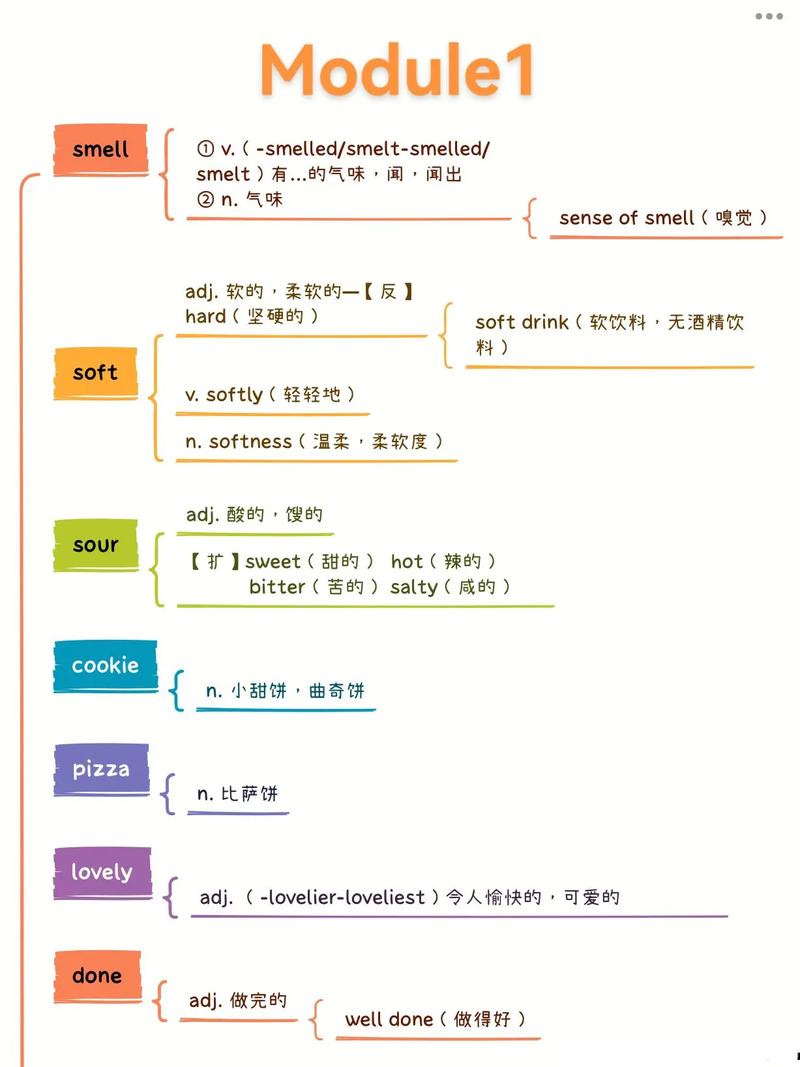
(图片来源网络,侵删)
- 礼貌地询问方向或信息:
- Could you please tell me where the bank is?
- Excuse me, could you tell me how to get to the post office?
- Pardon me? / Sorry, I didn't catch that. (没听清,请再说一遍。)
- 指路:
- It's on Center Street, next to the library.
- Go straight and turn left at the first crossing.
- You can't miss it. (你不会找不到的。)
分支4: 自然与天气 (Unit 4 Why don't you talk to your parents?)
- 表达烦恼:
- I'm really tired because I studied until midnight last night.
- I argued with my best friend.
- 提出建议:
- Why don't you talk to him about it?
- You should call him so you can say you're sorry.
- Maybe you could go to his house.
分支5: 社会与文化 (Unit 5 What were you doing when the rainstorm came?)
- 描述过去某个时刻正在进行的动作:
- What were you doing at 8:00 last night? (I was doing my homework.)
- When the rainstorm came, I was waiting for the bus.
- 讲述过去的故事:
- While Linda was sleeping, the alarm went off.
- Ben's family was watching TV when the storm started.
分支6: 社会问题 (Unit 6 An old man tried to move the mountains.)
- 讲述传说/故事:
- Once upon a time, there was a very old man...
- This story reminds us that anything is possible.
- 表达观点:
- I think the story is very interesting.
- What do you think of the story?
- In my opinion, we should never give up.
第四部分:学习方法与技巧
- 分支1: 词汇记忆
- 语境记忆法:在课文中、对话中记忆单词,而不是孤立地背。
- 词根词缀法:学习常见的前缀、后缀和词根,帮助猜测词义和扩展词汇量。
- 分类归纳法:将话题相关的单词(如疾病、天气、交通)整理在一起。
- 分支2: 语法巩固
- 对比学习法:将易混淆的语法点(如will/be going to, 一般过去时/现在完成时)放在一起比较。
- 造句练习:用每个语法点自己造5-10个句子,加深理解。
- 错题整理:准备一个错题本,记录做错的题目,并分析原因。
- 分支3: 听说读写
- 听力:坚持听课文录音,尝试听一些简单的英文动画或歌曲。
- 口语:大胆开口,可以自言自语,或者和同学、家人进行简单的英语对话。
- 阅读:每天阅读一篇适合自己水平的英语短文,理解大意即可。
- 写作:从仿写句子开始,再到写段落,最后尝试写短文。
如何使用这份思维导图:
- 预习:在学习新课前,先看一遍导图,了解本单元要学什么,做到心中有数。
- 复习:学完一个单元后,看着导图回忆知识点,检查自己哪些部分掌握了,哪些还需要加强。
- 期末考试前,用这份导图进行总复习,快速回顾整个学期的核心内容。
- 填充:你可以根据自己的课堂笔记和练习,在这份框架下添加更多细节,让它成为你专属的复习宝典。
希望这份思维导图能对你的英语学习有所帮助!祝你学习进步!