这份思维导图按照教材的单元主题进行划分,每个单元下又包含了核心句型、重点词汇、关键语法和话题功能,帮助你系统地梳理和复习。
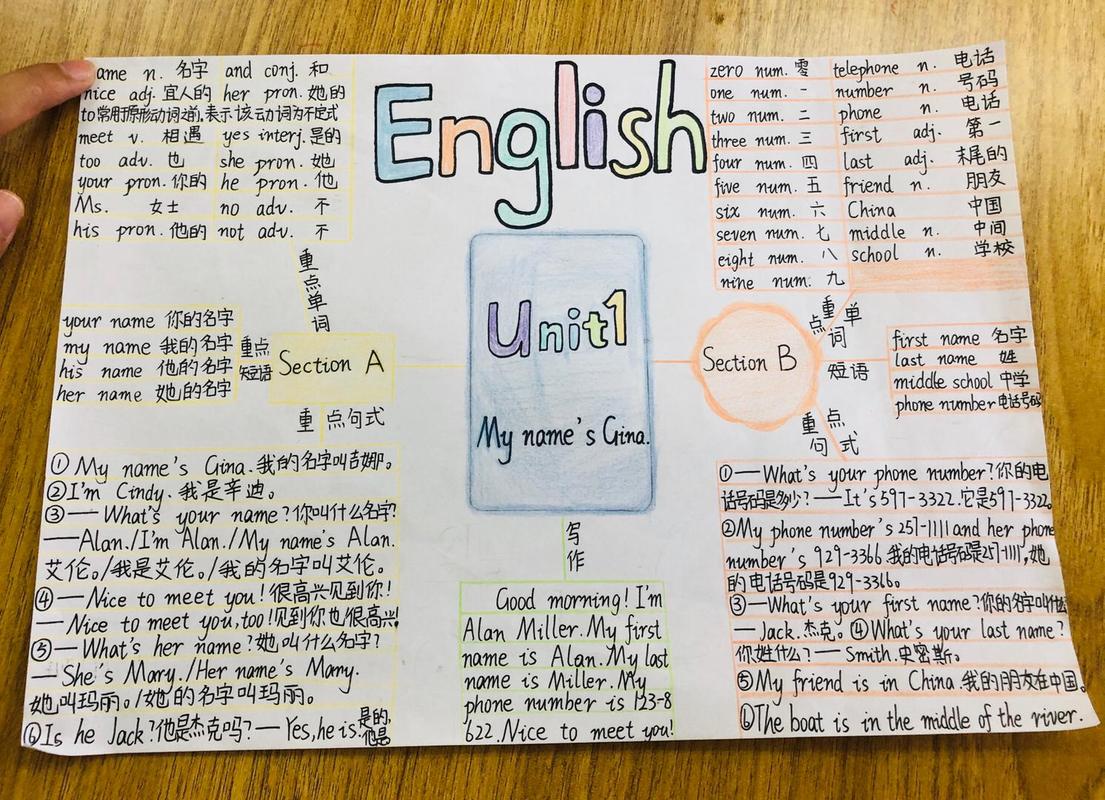
(图片来源网络,侵删)
七年级下册英语 全册知识结构总览
你可以把整个学期的知识想象成一棵大树:
- 树根 (Roots): 一般过去时 (最重要的时态之一)
- 树干 (Trunk): 情态动词 和 There be 句型
- 主要分支 (Main Branches): 各个单元的核心话题
- Unit 1: Can you play the guitar? (能力与邀请)
- Unit 2: What time do you go to school? (日常生活与时间)
- Unit 3: How do you get to school? (交通方式)
- Unit 4: Don't eat in class. (规则与建议)
- Unit 5: Why do you like pandas? (动物与喜好)
- Unit 6: I'm watching TV. (现在进行时)
- Unit 7: It's raining! (天气与感受)
- Unit 8: Is there a post office near here? (方位与地点)
- Unit 9: What does he look like? (外貌描述)
- Unit 10: I'd like some noodles. (点餐与食物)
- 树叶与果实 (Leaves & Fruits): 词汇、句型、语法
分单元思维导图详解
Unit 1: Can you play the guitar? (能力与邀请)
- 核心话题: 谈论个人能力,提出邀请和回应。
- 核心句型:
- — Can you...? (你会...吗?)
- — Yes, I can. / No, I can't.
- — What can you do? (你会做什么?)
- — I can (dance/swim/sing).
- — Let's join the... club. (让我们加入...俱乐部吧。)
- — That sounds good/great/boring. (听起来不错/很棒/很无聊。)
- 重点词汇:
- 能力类:
sing,dance,swim,draw,speak,play (the) piano/guitar/violin/drums - 俱乐部类:
club,swimming club,music club,art club,English club,chess club - 其他:
tell stories,show,talk,kung fu
- 能力类:
- 关键语法:
- 情态动词
can的用法:- 构成:
can + 动词原形 - 用法: 表能力、请求或允许。
- 否定:
can't / cannot + 动词原形 - 疑问句:
Can + 主语 + 动词原形...?
- 构成:
- 情态动词
- 话题功能:
- 询问和描述自己的特长。
- 发出、接受和拒绝邀请。
Unit 2: What time do you go to school? (日常生活与时间)
- 核心话题: 描述日常作息和时间安排。
- 核心句型:
- — What time do you...? (你...几点?)
- — I... at... o'clock. (我...点...。)
- — When do you...? (你什么时候...?)
- — I... at... (我...在...时候。)
- 重点词汇:
- 时间:
time,o'clock,half past,quarter past/to,a.m. / p.m. - 日常活动:
go to school,get up,run,eat breakfast,take a shower,go to work,go home,do homework,go to bed - 副词:
usually,always,never
- 时间:
- 关键语法:
What time和When的区别:What time通常指具体的时间点 (e.g., 7:00)。When可以指时间点或时间段 (e.g., 7:00 / in the morning)。
- 频度副词:
usually,always,never,sometimes的位置(通常在 be 动词、情态动词、助动词之后,实义动词之前)。
- 话题功能:
- 询问和描述自己及他人的日常活动。
- 使用频度副词谈论习惯。
Unit 3: How do you get to school? (交通方式)
- 核心话题: 谈论去某地的交通方式。
- 核心句型:
- — How do you get to...? (你怎么去...?)
- — I take the bus / subway / train. / I walk / ride a bike.
- — How does he/she get to...? (他/她怎么去...?)
- — He/She takes the bus / subway / train. / He/She walks / rides a bike.
- — How long does it take? (它花费多长时间?)
- — It takes about 20 minutes. (大约花费20分钟。)
- — How far is it from... to...? (从...到...有多远?)
- — It's about 10 kilometers. (大约10公里。)
- 重点词汇:
- 交通方式:
take the bus/subway/train/boat,walk,ride a bike/horse,by bus/subway/train/air/sea - 距离:
kilometer,mile - 时间:
minute,hour
- 交通方式:
- 关键语法:
- 特殊疑问词
how引导的问句:How(方式)How long(时间长度)How far(距离)
take的用法:It takes (sb.) some time to do sth.(某人花费时间做某事)。
- 特殊疑问词
- 话题功能:
- 询问和回答交通方式。
- 询问和回答路程距离及花费时间。
Unit 4: Don't eat in class. (规则与建议)
- 核心话题: 谈论规则、义务和禁止。
- 核心句型:
- (祈使句)
Don't...(不要...。) - — Can we...? (我们能...吗?)
- — Yes, we can. / No, we can't. / We have to... (我们必须...。)
- — What are the rules? (规则是什么?)
- — We must be on time. / We have to wear uniforms. (我们必须准时。/ 我们必须穿校服。)
- (祈使句)
- 重点词汇:
- 规则:
rule,classroom,hallway,dining hall,fight,arrive,late,listen,music,wear,uniform,outside,hall - 情态动词:
must(必须),have to(不得不)
- 规则:
- 关键语法:
- 祈使句: 用于表达命令、请求或建议,否定形式为
Don't + 动词原形。 mustvshave to:must侧重于主观看法(个人认为必须)。have to侧重于客观要求(外界规定,如规则、法律)。
- 祈使句: 用于表达命令、请求或建议,否定形式为
- 话题功能:
- 描述和谈论不同场所的规则。
- 使用
must,have to,can,can't表达义务、禁止或许可。
Unit 5: Why do you like pandas? (动物与喜好)
- 核心话题: 谈论动物及其特点,并说明喜好的原因。
- 核心句型:
- — Why do you like...? (你为什么喜欢...?)
- — Because they are... (因为它们是...。)
- — What animals do you like? (你喜欢什么动物?)
- — I like... (我喜欢...。)
- — Where are they from? (它们来自哪里?)
- — They are from... (它们来自...。)
- 重点词汇:
- 动物:
panda,tiger,elephant,koala,lion,giraffe,penguin,zoo,cute,smart,ugly,friendly,beautiful,scary,lazy,kind - 国家/地区:
China,Australia,South Africa,Thailand
- 动物:
- 关键语法:
Why引导的特殊疑问句: 询问原因,回答用Because...。Where引导的特殊疑问句: 询问来源地,回答用They are from...。
- 话题功能:
- 描述动物的外貌和性格特点。
- 表达对动物的喜好并说明原因。
Unit 6: I'm watching TV. (现在进行时)
- 核心话题: 描述当前正在发生的动作。
- 核心句型:
- — What are you doing? (你在做什么?)
- — I'm watching TV. (我在看电视。)
- — Is he/she reading a book? (他/她在读书吗?)
- — Yes, he/she is. / No, he/she isn't.
- 重点词汇:
- 动词:
watch TV,clean,read,eat,make soup,wash,study,go shopping - 地点副词:
here,there
- 动词:
- 关键语法:
- 现在进行时:
- 结构:
am/is/are + 动词-ing - 用法: 表示说话时正在进行的动作。
- 动词-ing 构成规则:
- 一般直接加
-ing(e.g.,do->doing) - 不发音的
e去e加-ing(e.g.,make->making) - 重读闭音节结尾,双写末尾辅音字母加
-ing(e.g.,sit->sitting) - 以
-ie变ie为y加-ing(e.g.,lie->lying)
- 一般直接加
- 结构:
- 现在进行时:
- 话题功能:
询问和描述某人此刻正在做的事情。
Unit 7: It's raining! (天气与感受)
- 核心话题: 描述天气情况和人们的感受。
- 核心句型:
- — How's the weather? / What's the weather like? (天气怎么样?)
- — It's sunny/rainy/windy/cloudy/snowy. (天气晴朗/有雨/有风/多云/下雪。)
- — How is it going? / How's everything going? (最近怎么样?)
- — Great! / Not bad. / Terrible! / Pretty good.
- 重点词汇:
- 天气:
weather,sunny,cloudy,rainy,windy,snowy,hot,cold,cool,warm - 感受:
happy,sad,relaxed,bored,terrible,great,not bad - 活动:
study,watch TV,play basketball,cook,walk
- 天气:
- 关键语法:
- 描述天气的句型:
It's + 形容词.(e.g.,It's rainy.) - 询问感受的句型:
How + be 动词 + 主语?(e.g.,How are you?,How is it going?)
- 描述天气的句型:
- 话题功能:
- 谈论不同地方的天气。
- 描述自己的感受和正在做的事情。
Unit 8: Is there a post office near here? (方位与地点)
- 核心话题: 询问和描述地点方位。
- 核心句型:
- — Is there a... near here? (这附近有...吗?)
- — Yes, there is. / No, there isn't.
- — Where is the...? (...在哪里?)
- — It's on/in/next to/across from... (它在...的旁边/里面/对面...)
- — Are there any...? (有...吗?)
- — Yes, there are. / No, there aren't.
- 重点词汇:
- 地点:
post office,library,restaurant,bank,hospital,supermarket,street,park,pay phone - 方位介词:
on(在...上面),in(在...里面),next to(紧挨着),between...and...(在...和...之间),across from(在...对面),near(在...附近)
- 地点:
- 关键语法:
- There be 句型:
- 含义: 表示“存在”,即“某地有某物”。
- 单数:
There is a/an + 名词单数 + 地点. - 复数:
There are (some) + 名词复数 + 地点. - 疑问句:
Is/Are there...? - 就近原则:
be动词的形式由它后面的第一个名词决定。
- There be 句型:
- 话题功能:
- 询问和确认地点。
- 使用方位介词清晰地指路。
Unit 9: What does he look like? (外貌描述)
- 核心话题: 描述人的外貌和身材。
- 核心句型:
- — What does he/she look like? (他/她长什么样?)
- — He/She is of medium height/build. (他/她中等身高/体型。)
- — He/She has long straight hair. (他/她是长直发。)
- — What do they look like? (他们长什么样?)
- — They are short. / They have short curly hair. (他们个子矮。/ 他们是短卷发。)
- 重点词汇:
- 身高:
tall,short,of medium height - 体型:
thin,heavy,of medium build - 发型:
long hair,short hair,curly hair,straight hair - 面部特征:
glasses,round face,long face
- 身高:
- 关键语法:
- 描述外貌:
- 描述整体:
be + 形容词(e.g.,He is tall.) - 描述具体特征:
have/has + 名词(e.g.,She has long hair.)
- 描述整体:
- 注意:
look like强调整体样貌,而be like可以指外貌也可以指性格。
- 描述外貌:
- 话题功能:
- 描述自己或他人的外貌特征。
- 根据描述辨认出某人。
Unit 10: I'd like some noodles. (点餐与食物)
- 核心话题: 在餐厅点餐,谈论食物和饮料。
- 核心句型:
- — What kind of noodles would you like? (你想要哪种面条?)
- — I'd like beef and tomato noodles. (我想要牛肉西红柿面。)
- — What size bowl of noodles would you like? (你想要多大碗的面?)
- — I'd like a large/medium/small bowl. (我想要一大/中/小碗。)
- — Can I help you? (请问要点什么?)
- — Yes, I'd like... (是的,我想要...)
- 重点词汇:
- 食物:
noodles,beef,chicken,mutton,cabbage,potato,tomato,special,rice,dumpling,porridge,soup - 饮料:
tea,juice,cola,water - 大小:
large,medium,small - 点餐:
would like,order,menu,dollar,price
- 食物:
- 关键语法:
would like的用法:- 含义: “想要”,比
want更委婉、礼貌。 - 结构:
would like + sth./would like to do sth. - 缩写:
I'd like = I would like,He'd like = He would like
- 含义: “想要”,比
- 话题功能:
- 在餐厅礼貌地点餐。
- 询问和回答食物的种类、大小和价格。
如何使用这份思维导图?
- 课前预习: 看着导图的核心话题和核心句型,提前了解本单元要学什么。
- 课堂笔记: 上课时,把老师讲的重点词汇、语法规则补充到对应的分支下。
- 课后复习: 每学完一个单元,合上书本,看着导图自己复述出每个部分的内容,检查哪里记得不牢。
- 考前总览: 在期末考试前,把这份总导图看几遍,快速回顾整个学期的知识框架。
希望这份详细的思维导图能帮助你更好地学习七年级下册英语!加油!
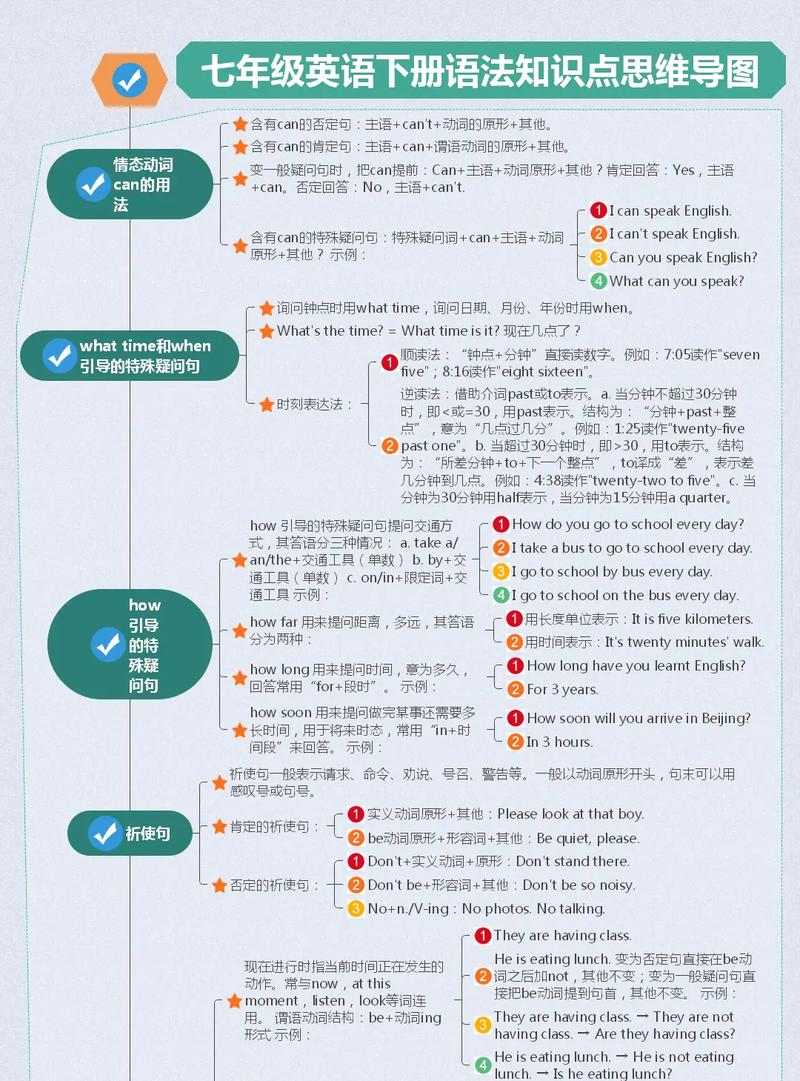
(图片来源网络,侵删)